

Technology
AI that shows its work, so planners can sign it off.
Public transport decisions are public. Every saving has to survive a board meeting, a union negotiation and an audit. Blixar’s engine is built so each answer can be checked: named algorithms, printed bounds, stated caveats.
AI capabilities
The AI behind every plan.
Generative & language AI
Plain-language questions answered from your own network data.
- Generative AI
- Large language models
- AI agents
- Retrieval-augmented generation
- Natural-language querying
Machine learning & perception
Patterns learned from ridership, operations and sensors.
- Machine learning
- Predictive analytics
- Ridership analytics
- Computer vision
- Edge AI
Optimisation & simulation
Provably good plans, with the reasoning shown.
- Mathematical optimisation
- Operations research
- Geospatial AI
- Digital twins
- System Dynamics simulation
- Explainable AI
The engine
Four kinds of intelligence, one engine.
“AI” in transit usually means a chatbot. Most of the value is in operations research, graph algorithms and geospatial analysis, with language models used where they help a planner ask a question, not where they would guess an answer.
Mathematical optimisation
Vehicle blocking, charging and crew problems solved by a portfolio of named algorithms, from greedy construction to exact set partitioning, with bounds that prove how good the answer is.
Graph & matching algorithms
Duties paired by matching with alternating-path augmentation; rosters completed with augmenting paths; route groups for driver knowledge found by optimal set cover.
Geospatial intelligence
Catchments, walking access, corridor overlap, detours spliced into official alignments and dead mileage routed depot-to-terminal on the real road network.
Language models, grounded
A planning assistant that answers by calling the same analyses the tools use, then draws the result on the map. It falls back to deterministic search when no model is configured.
Explainable by design
Six rules every result follows.
- 01
Named, not branded
Algorithms are named on screen. A planner can see which strategy produced a schedule and run another beside it.
- 02
Bounded
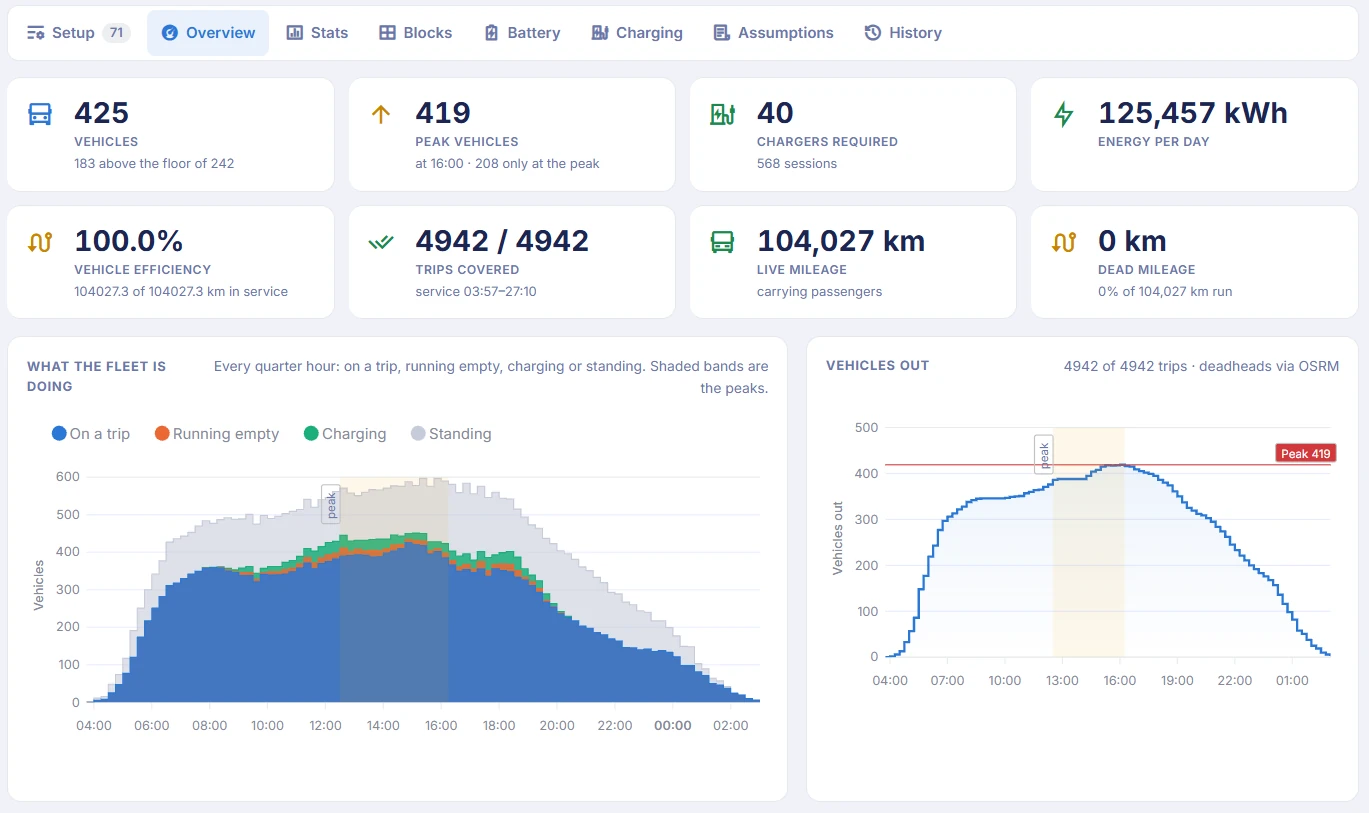
Every vehicle solve prints the timetable floor and the energy floor next to the answer.
- 03
Diagnosed
Plans explain themselves: what ended each duty, why a day went uncovered, drivers per peak bus.
- 04
Footnoted
Every saving carries its cost: riders who now walk further, kilometres a detour puts back.
- 05
Guarded
Terminals are never removed, corridors never left unserved, and a stop only goes if a kept stop is within a walk.
- 06
Reproducible
Every run is kept with its inputs, so it can be reopened, compared and exported months later.
Vehicles and crews, together
The trade classic suites never see.
A longer main break costs buses and saves duties; a shorter one does the reverse. Blixar prices a schedule as fleet plus crew and searches the trade between them, producing a cost frontier the planner picks from. Sequential tools solve vehicles, then crews, and never see it.
- Sensitivity built in: break length, routes per driver, depot flexibility and charger count as curves
- Long solves run in the background with live progress
- Every result is a chart and a downloadable table
Deployment & security
Runs where your data already lives.
Network, ridership and crew data are sensitive. Blixar is designed to be self-hosted from day one, and governed so published figures stay published.
Deploy where your data lives
Our cloud, a private cloud in your jurisdiction, or on-premise. Nothing is shipped to a third party to be processed.
Roles & feature flags
Read-only and editing roles, and every analysis behind a switch, so capabilities roll out one at a time.
Locked reporting
Published months are frozen. Writes into them are refused; only an administrator can unlock.
Sources of record
Each figure has exactly one owner, and every uploaded file is stored with what it wrote and who applied it.
Monitored & backed up
Prometheus and Grafana monitoring, automated backups and disaster recovery on every managed deployment.
No lock-in
Open formats in and out: GTFS, KML, spreadsheets and PDF. Your data leaves with you whenever you want.
Built on
Put the engine on your network.
Send us a GTFS feed and we will show you the lower bound for your timetable, and how far today’s schedule sits from it.