

SRSchedura · Scheduling & Rostering
Fewer buses. Fairer rosters. One plan.
Schedura finds the fewest buses, chargers and drivers that can run your timetable, and shows you how close to the best possible it is. One data model from the map to the driver’s printed duty sheet.
- solver strategies
- 14
- modules, one data model
- 6
- fewer duties on a real board
- −6%
The problem
The timetable decides your costs long before the first bus leaves.
Every bus operator pays for three things the timetable does not show: buses standing at terminals, chargers nobody can reach at the peak, and drivers rostered for work that was never there. Those costs are decided in the vehicle schedule and the crew roster.
Most networks still make those decisions in spreadsheets or in tools built for diesel fleets in the 1990s. Electrification breaks them: a battery turns a chaining problem into an energy, charger and depot problem. Crew planning suffers the same way: duties cut by hand, rosters that drift unfair over the month, and an hour on the phone for every sick call.
The result is fleets 10 to 20 percent larger than the timetable needs, and no quick answer to the board’s question: what would it cost to run this timetable electric, from this depot, with this many routes per driver?
Modules
Six modules share one data model.
A route drawn in the morning can be blocked, crewed and rostered by the afternoon.
Network & timetables
Routes, stops and timetables on a map.
- Route builder with road snapping
- KMZ/KML and spreadsheet import
- Timetable bands and headways
GTFS
Publish and maintain feeds.
- Agencies, services and calendars with overlap checks
- Feeds regenerated as background jobs
Vehicle blocking
Chain trips into bus days for the fewest vehicles.
- 14 solver strategies
- Electric energy and charging model
- Depots, chargers and bus types as decisions
Crew scheduling
Cut blocks into legal duties.
- Duty rule sets: spread, driving, breaks
- Relief points
- Pieces paired across buses
Rostering
Named drivers on every duty, up to a quarter ahead.
- One rest day a week
- Hours levelled per calendar month
- Route knowledge and vehicle class respected
Daily operations & leave
Run the day and learn from it.
- Ranked cover, swap, reassign, cover-all
- Standby by depot and change log
- Crew board and duty sheets as PDF
The optimisation engine
Fourteen algorithms, one button, a bound beside every answer.
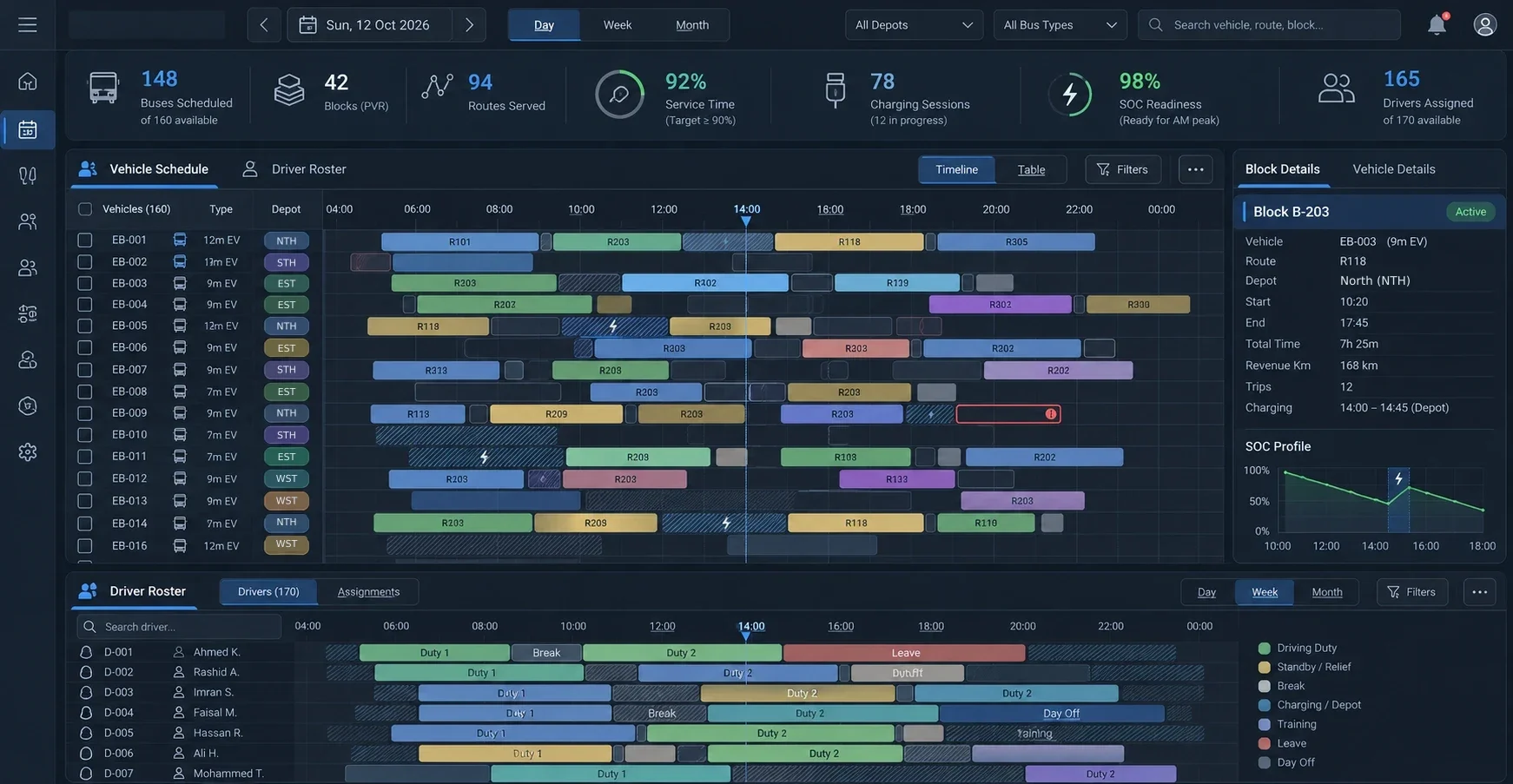
Vehicle blocking is a portfolio of solvers, not a single heuristic. Pick a strategy or leave it on Automatic, which runs the constructions and keeps the best. Comparison mode runs several on the same scenario and shows fleet, deadhead and energy side by side.
| Family | Strategies | What it is good at |
|---|---|---|
| Constructive | Best fit, first fit, longest idle, most charge, most range after the trip | Seconds on any size of network; the diesel answer matches the timetable’s lower bound |
| Randomised | Randomised restarts, genetic algorithm, HASP hybrid (genetic with swap descent) | Escaping the pattern a greedy rule locks into |
| Local search | Simulated annealing, tabu search, adaptive large neighbourhood search | Improving a good schedule under charger and range limits |
| Exact and column based | Set partitioning (MILP), column generation with price and branch | Proving how good the answer is on a depot’s pool of trips |
What makes it different
The allocation is a decision, not an input.
Fixed mode keeps the operating plan as it stands. Flexible mode lets the solver choose depot and bus type for every route. Mixed mode releases a chosen handful of routes, which is usually where the case for change is made.
A lower bound beside every answer.
Each solve reports the timetable floor and the energy floor, so a planner sees whether a fleet of 131 is within two percent of the best possible or twenty above it.
Every solve is a scenario.
Clone it, change one thing, solve again, compare. Peak vehicle requirement, blocks per peak bus and duties per block are reported, so the vehicle schedule takes the blame it deserves before the crew count does.
Built for electric fleets
Energy, chargers and depots planned inside the block.
On a benchmark depot of 12 routes and 1,545 trips the diesel answer meets the timetable floor of 124 buses exactly. The electric answer is judged against that same floor, and every improvement to the charging model is measured as buses taken off the peak.
Crew: from blocks to a fair month
The driver takes the break. The bus keeps running.
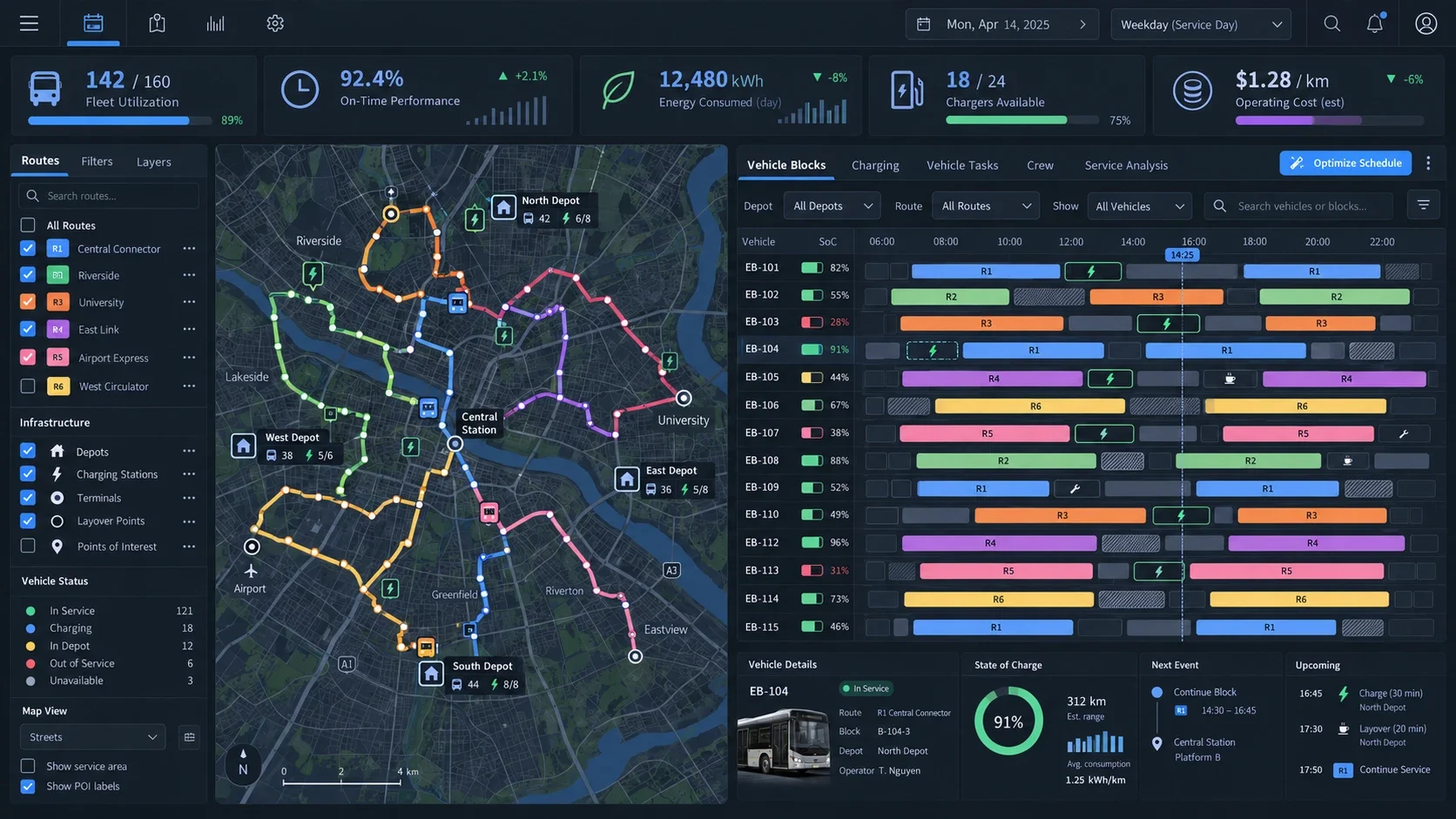
The crew side is a pipeline of four algorithms, each reported with its own count, so a planner can see where the drivers went.
- 01Vehicle blocks
- 02Pieces of work at relief points
- 03Duties matched across buses
- 04Roster, a day at a time
- 05Levelled month
- 06Daily operations
Duties matched, not guessed
Each block is cut where a driver can legally change over. Pieces are paired into duties by matching with alternating-path augmentation rather than a greedy rule. On a real board: 1,601 duties down to 1,501 for the same driving.
A roster that stays fair
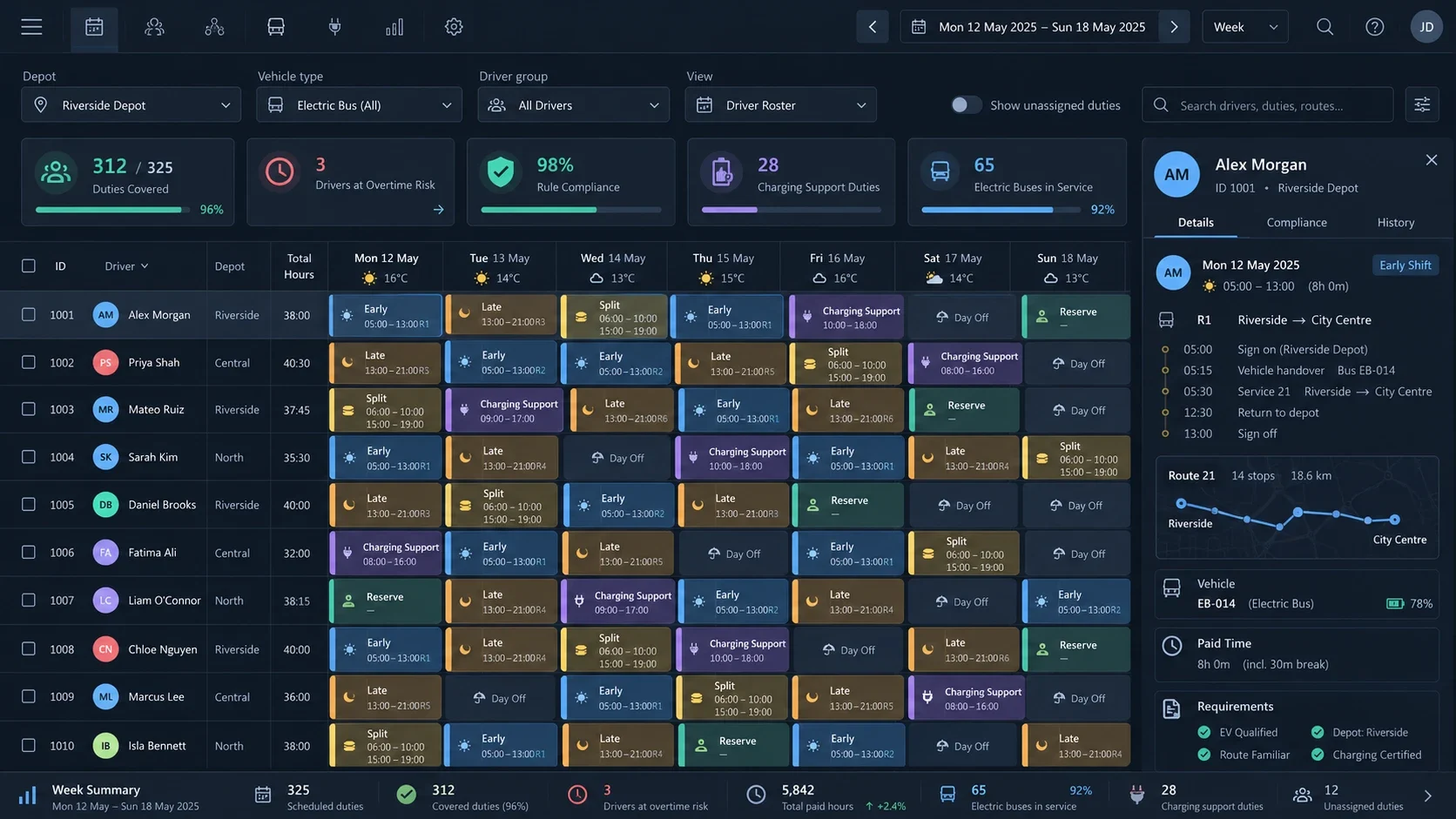
Each day’s duties go to the least-loaded qualified driver, then augmenting paths complete the day, so no duty is left uncovered while a legal chain of hand-overs exists. Hours are levelled inside each calendar month.
The establishment you really need
When a depot is short, the plan says why and fixes it: training the closest drivers, then hiring until every duty-day has a name. Sizing studies show drivers required at five, six, up to ten routes per driver.
Daily operations
A sick call takes minutes, not an hour.
Mark a driver absent and every duty they held is stood down. The standby table shows who can be called on at each depot, and one click covers the gaps with the best-qualified free driver.
- Absences, ranked cover candidates, swap and reassign
- Leave accounts, planner and change log
- Crew board and duty sheets printed as PDF
- What actually happened sets the next plan’s cover factor
What would it cost to run your timetable electric?
Send us a GTFS feed or a timetable export. We will run the first scenario with you: buses, chargers and drivers, with the lower bound beside every answer.